Just about anyone who has spent a moment listening to the radio or even just doom-scrolling online could probably say that “Chop Suey” was their first System of a Down song. It may have been just a snippet of the song, since it’s been featured in so many internet meme videos. You can go on TikTok or really any short form video app and hear it featured in countless videos done by creators beyond the nu metal scene. For a generation, it may be recognized from rhythm games, such as the iconic Rock Band 2. Regardless, it is easily their most popular and iconic song, with over 2 billion streams on Spotify alone. This all is no mean feat for a song whose name is a play on the word "suicide." More on that later, though.
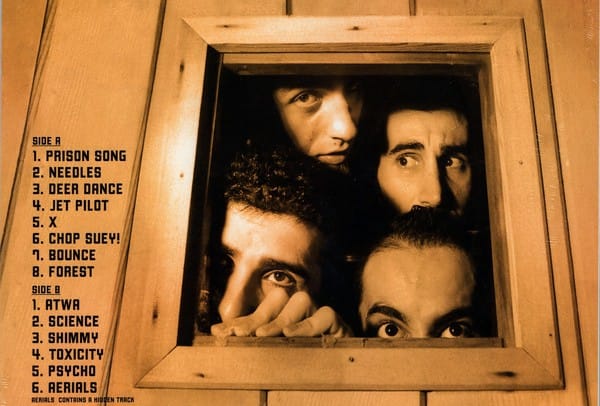
Toxicity was released on September 4th, 2001 under American Recordings and Columbia Records. It was an expansion on their debut self-titled album from 1998, going on to really solidify the band, their musical influences, and subjects such as social issues and politics. On tracks such as "Science" and "Aerials," we see hints of Armenian music, while the hidden track "Arto" is a cover of an Armenian church anthem, "Der Voghormia," paying proper homage to their Armenian roots. Not every song on the album explicitly handles a sociopolitical issue, but so many do, namely "Science," "Needles," "Prison Song," and "X."
The record opens with the heavy-riffed and (sadly) still topical "Prison Song." It highlights the hypocrisy found in drug-related arrests. Many people in Hollywood are known drug users and nothing is done about it, while someone in your small town can be arrested for the same ounce that is passe in California. Considering the lack of retroactive laws in states that have legalized marijuana, some of these individuals are still incarcerated for something totally legal now. There is also the fact that a surveillance state is a prison “for you and me to live in,” something even more topical in the age of Flock cameras. Despite famous notable people committing significantly worse crimes, we see so many people getting the book thrown at them for things like minor drug offenses. "Prison Song" worked in 2001, and in some ways is even more topical now in 2026.
Next we have "Needles," another heavy song with a heavy subject, being about the struggles of addiction. Addiction can control so many aspects of one person’s life in this song being represented by a “tapeworm.” With lyrics like “‘Cause you, my tapeworm tell me what to do / You, my tapeworm tells me where to go.” In a quite vulgar, yet so very metal way, System of a Down tells you to “pull the tapeworm out of your ass.” It’s a way to show beating addiction can be difficult, but must be done to be free of the hold the “tapeworm” has on you.
Somehow, even with this not safe for work lyric, Toxicity is the only album in System's discography not to bear a Parental Advisory sticker. Funny, that.
Another incredibly topical song comes next in the form of "Deer Dance," a song about how police use force against civilians, more specifically police brutality against peaceful protesters, something we see way too often today, especially in the United States with anti-ICE protests. The lyric “pushing little children with their fully automatics, they like to push the weak around” highlights how they will attack anyone, including and especially the weak. Another very notable lyric is “We can’t afford to be neutral on a moving train," noting how we can’t be neutral with our activism, especially in times of change. "Deer Dance" as a whole is about the youths protesting war and the way police will brutalize them all with a smile on their face, performing a “service with a smile,” if you will.
"Jet Pilot" and "X" are less-discussed songs, though their respective messages are still relevant. "Jet Pilot" is one of many System of a Down songs that highlights Armenian history, this one being about the bombings in Armenia that are part of the still ongoing Nagorno-Karabakh conflict between Armenia and Azerbaijan. Conversely, "X" is a song about immigration and overpopulation, with one of the main lines being “tell the people that arrive, we don’t need to multiply.” It’s another song highlighting Armenian history, particularly the Armenian Genocide, a topic that is very near and dear to the band, as they played a massive part in bringing attention to a still-much ignored part of human history.
Here it is, one that everyone knows, I bet your mom even knows it, "Chop Suey!", System of a Down’s most popular song by a mile. As mentioned previously, the name is a play on the word "suicide." The song was originally intended to be called “Self-Righteous Suicide,” but got pushback due to the use of the word "suicide" in the title. At the behest of the band, the word play became “self-right-Chop Suey-cide.” If you listen closely to the start of the song you can hear Serj Tankian say “we’re rolling ‘Suicide’” as a way for the band to covertly get the old title mentioned. On top of this, the song was one of countless that was deemed “too inappropriate/offensive” by Clear Channel Communications (now iHeartMedia) for radio play following the September 11th attacks on the United States.
"Bounce" is a song about sex, full stop. The lyrics imply it’s an orgy with lines like “she had so many friends (gliding through my hands)” and “everyone gets to play," with the “pogo stick” clearly being a euphemism for penis. Not even the sometimes dead-serious System Of A Down can resist a good dick joke, and this was years before we found out that Daron's cock was much bigger than yours. "Forest" is a song that highlights our relationship with nature via lyrics that read as Mother Nature speaking to us: “Walk with me my little child, to the forest of denial.” It is a beautiful way of describing our willful ignorance to the destruction of nature around us. We are the earth, we are part of it. we are an animal living on this planet, shouldn’t that be enough?
Next we have "ATWA," which stands for "Air, Trees, Water, Animals." The abbreviation is an ecological belief system tied to the notorious killer and cult leader Charles Manson. Malakian, who wrote the song, clarified that he does not condone murder or any of the actions, instead drawing inspiration from the things we know Manson for from what we see on the news. He was more intrigued by his views on society and nature, themes we see a lot in Toxicity as a whole.
This perfectly lets us look at the next song, Science, a truly underrated song. This is a song that instead of looking at the positives of scientific advancements looks at the more negative aspects as well as science vs. religion (“Science has failed our world, Science has failed our Mother Earth,” “Science has failed to recognize the single most potent element of human existence. Is letting the reigns go to the unfolding is faith”). As well, this is another song that has ties and nods to the band’s Armenian heritage with notes of Armenian style music and the lyric “Sim hayastani de anush de im, arevaham barr nem sirum” which is a line from an Armenian poem which roughly translates from my research to “I love the sweet words of my beloved Armenia” or “I love the sweet fruit of my beloved Armenia.” After "Science," we have "Shimmy," a song that highlights indoctrination in schools. We go to school and we are taught what they want us to know. We go along with it, something that isn’t discussed like it should be.
"Toxicity," the titular song of the album, is one of System of a Down’s biggest hits and one of their songs in the Spotify Billions Club. With a quiet gentle strum into a heavy riff, it starts strong, with more notes of their Armenian influences. Serj has gone on to speak of the spiritual aspects of "Toxicity" such as the ties that the line “sacred silence and sleep” has to Indigenous American spirituality. Notes of Armenian culture can be found in the lyric “eating seeds as a pastime activity,” as eating sunflower seeds is something a lot of Armenian families do, according to Malakian, who stated that his own family does it often.
After this comes "Psycho," a heavy song with a catchy beat that highlights the chaos of being in the metal scene and what comes with it, with the song opening “Psycho, groupie, cocaine, crazy.” It breaks down into “normal” people thinking you’re “psychotic” (the heavier the metal, the more “psycho”), not to mention there are so many groupies in the rock and roll world (“so you want to see the show? You really don’t have to be a ho”), the world of rock and metal is full of drugs (“gets you high” and “so you want the world to stop?”). And it'll all drive you crazy, natch.
Closing the record is another iconic track - and a brand new member of the Spotify Billions Club - "Aerials." Its iconic intro riff breaks away into gorgeous lyrics, making for one of System of a Down’s most beloved and beautiful songs. Its surreal music video takes place in a circus, featuring a boy with an alien-like appearance. We see him as he dreams of being adored and praised by everyone around him. He’s surrounded by people who adore him, want to interview him, and take pictures of him. As we watch the band perform, we can see the aerial performers in the background, the young boy admiring them as he thinks about being surrounded by cash. However, we are slowly watching the boy get frustrated too, ultimately with the video ending of him lying alone in the middle of the circus tent. The video ties in with the themes of opening our minds and being more understanding in life, with the final verse ending with the line “when you lose small mind, you free your life.”
Our final and closing song is unique in that it is a completely instrumental piece, outside of Armenian chanting. Originally called “Arto,” after the musician featured on it with the band, the song “Der Voghormia” was a hidden track on Toxicity at the start, being put with the ending of "Aerials." "Der Voghormia" translates to “Lord have mercy,” and is a traditional Armenian hymn mostly used in funerals and for occasions such as commemorations of the Armenian Genocide. This truly highlights the importance of the Armenian heritage the band shares and the importance of the country’s history to them. It’s nothing like anything else on the album, and that makes it truly special.
While there are no re-release plans for Toxicity’s 25th anniversary, System of a Down is currently on tour and celebrating the album in other ways. Five cities in Europe will see System play there, namely Paris, Stockholm, Düsseldorf, Berlin and London. This tour also marks their first appearance back in Europe since 2017.
System of a Down will also be in Fort Worth, Texas to headline the Sick New World Festival this October.